
See your own stages on a deal board
In a demo we set up your stages with win probability and stall limits in Lumo, so you see how your pipeline looks. Or request a trial workspace.
A pipeline stage is only useful when everyone means the same thing by "this deal is in Quote sent". This guide gives you an example pipeline with exit criteria and win probability per stage, variations by type of business and a way to calibrate stages on your own history.
Open the deal board of an average B2B team and you see it straight away. Forty deals sit in Quote sent. Some really received a quote. Others are there because the rep will send one "soon". A few have been there since last year because nobody dares to close them.
The result: the pipeline says there is half a million in the late stages, and at the end of the quarter only a fraction closes. The sales manager stops trusting the board and walks around every Monday asking what is "really" going on. Reps see the pipeline as admin for the boss.
That is not a people problem. It comes from stages that describe what the rep does instead of what the buyer has done. "Prepare quote" is a task for the rep. "Buyer has received the quote and named a date to decide" is a fact you can check.
That is the difference between a stage and an exit criterion. An exit criterion is the condition a deal must meet before it can move to the next stage. It is always something the buyer said or did, never something the rep feels. And you can check it: is it in a note, an email or an activity on the deal?
With clear exit criteria every stage means something. Weighted value adds up, your sales forecast works and you can see where deals get stuck. Then you can give each stage a win probability based on what actually happens, and a limit after which a deal counts as stalled.
This guide is about which stages to choose and what they mean. How to build the pipeline in your CRM after that is covered in how to set up a sales pipeline.
An example pipeline for B2B sales with a conversation, a proposal and a decision on the buyer side. The win probabilities are starting values. Adjust them once you have your own numbers.
| Topic | Exit criterion (the deal moves on when) | Win probability and stall limit |
|---|---|---|
| 1. First meeting booked | A meeting is booked with a decision maker or someone reporting directly to one, with a date in the calendar. | 10%, stalled after 14 days |
| 2. Needs confirmed | The buyer has named a problem you solve, there is a reason to decide now and you know who else decides. | 25%, stalled after 21 days |
| 3. Demo or proposal discussed | The buyer has seen your approach and said it fits. Budget and timeline have been discussed. | 40%, stalled after 21 days |
| 4. Quote sent | The buyer has received the quote and named a date when they will decide. | 60%, stalled after 14 days |
| 5. Negotiation | The buyer has said they want to go ahead, and terms, price or timing are being discussed. | 80%, stalled after 10 days |
| Won | The quote or contract is signed. | 100% |
| Lost | The buyer said no, or there was no response after three attempts. Always with a lost reason. | 0% |
An example, not a standard. Win probabilities and limits depend on your market, deal size and sales cycle.
An exit criterion has to pass three tests.
It is about the buyer. "We prepared a proposal" is not an exit criterion. "The buyer discussed the proposal with their director" is. The question is always: what did the buyer say or do?
It can be checked. A colleague who opens the deal must be able to see the criterion was met. That means a note, an email or an activity on the deal. "I have a good feeling" cannot be checked.
It is binary. Met or not met. Never "sort of". If you are in doubt, it is not met.
Put exit criteria where everyone sees them. In the stage description in your CRM, on screen during the sales meeting, and in onboarding for new reps. Review them once a quarter.
Five to seven open stages work for most B2B teams. Fewer than four and you cannot see where deals stall. More than eight and reps skip stages or only move deals at the end. Won and lost do not count as open stages.
A made up deal to show how exit criteria work in practice. A software company sells a scheduling tool to an installation firm with sixty field engineers. In this example the rep is called Eva.
First meeting booked. The operations director fills in a form on the website. Eva calls the same day and books a forty five minute meeting for the following week. The director is a decision maker, so the exit criterion is met. The deal gets a provisional value based on the number of engineers.
Needs confirmed. In the meeting the director explains that planners lose two hours every morning moving jobs around in a spreadsheet, and that the current contract ends in four months. That is a problem and a reason to decide now. Eva asks who else is involved: the finance director and the head planner. She adds a note to the deal and moves it.
Demo or proposal discussed. Eva runs a demo for the director and the head planner using their own example. The head planner says it fits if the link with their time tracking works. Budget and timeline are discussed. The deal moves on.
Quote sent. Eva sends a quote. The director says the finance director will review it within two weeks and names a date. Without that date the deal would have stayed in the previous stage, with a task to ask for one.
Negotiation. The finance director wants different payment terms. The buyer wants to go ahead and the talk is about terms. The deal is in Negotiation.
Won. Eight days later the quote is signed.
At every point a colleague could open the deal and see why it was in that stage. That is the whole point of exit criteria.
The example pipeline is a start. This is how you adapt it to the way you sell.
Add a stage Site survey done after Needs confirmed. Exit criterion: the survey is done and the buyer has seen the findings. That is often when the real price is set.
Replace Demo or proposal discussed with Trial running, with the exit criterion that the buyer is actively using it. Give that stage a short stall limit, because a trial without usage dies quickly.
Create a separate pipeline for growth with existing customers. Those deals need fewer stages: Opportunity spotted, Proposal made, Trial order, Won.
Add a Pitch stage if you often pitch against others. Exit criterion: the buyer has named a decision date and you know how many parties are pitching.
Use a separate pipeline where the stages follow the steps of the procedure. Win probabilities are less useful here, so steer mainly on deadlines.
A separate renewal pipeline with stages like Meeting booked, Proposal sent and Renewed. Start three months before the end date.
The win probabilities in the template are a start. After six months you have enough data to adjust them. This is how it works, with made up numbers.
Take every deal closed in the last twelve months, won or lost. For each stage, count how many deals ever reached it and how many of those were eventually won.
In this example the real win probability at Quote sent was lower than the 60% in the template. You have two options. Lower it to 53%, or look at why deals drop out after the quote and make the exit criterion of the stage before it stricter.
Do not do this with fewer than twenty won deals. With less data, one deal is the difference between 40% and 60%. Use the starting values instead and check again in six months.
Look at time per stage at the same time. How long does a deal that ends up won spend in each stage on average? Set the stall limit at roughly one and a half times that. A deal that sits longer deserves a conversation. For the related numbers, see the guide on sales KPIs.
"Prepare quote", "Call", "Book meeting". Those are activities, not stages. A stage says where the buyer is. What the rep needs to do belongs on the deal as an activity.
Adding a stage every time something unusual happens makes the pipeline unreadable. Use a label or a field for exceptions. Keep stages for the path most deals follow.
A lead that is not yet qualified does not belong on the deal board. Keep leads separate until they meet your qualification, then create a deal. Otherwise they clutter the first stage and your conversion never adds up. More in the guide on lead follow up.
Deals that never close keep inflating the pipeline. Agree that a deal is lost after three attempts without a response, with a reason. You can always reopen it.
Sometimes a deal jumps from stage 2 to stage 4. That is fine if the exit criteria of stage 3 are also met. Agree to check that whenever a stage is skipped.
New business, growth and renewals work differently. One pipeline for all three means none of them fits. Two or three pipelines with five stages each are clearer than one with twelve.
In Lumo you set your own stages per pipeline. Each stage gets a win probability and a "rots after N days" setting. The deal board shows the number of deals, the value and the weighted value per stage, and a deal that sits too long gets a warning.
Every stage change is stored with the time the deal spent in the stage. That lets you calibrate win probabilities and stall limits as in the worked example above, with a report instead of a spreadsheet. Lost reasons are managed in settings. Read more about pipeline management or reports.
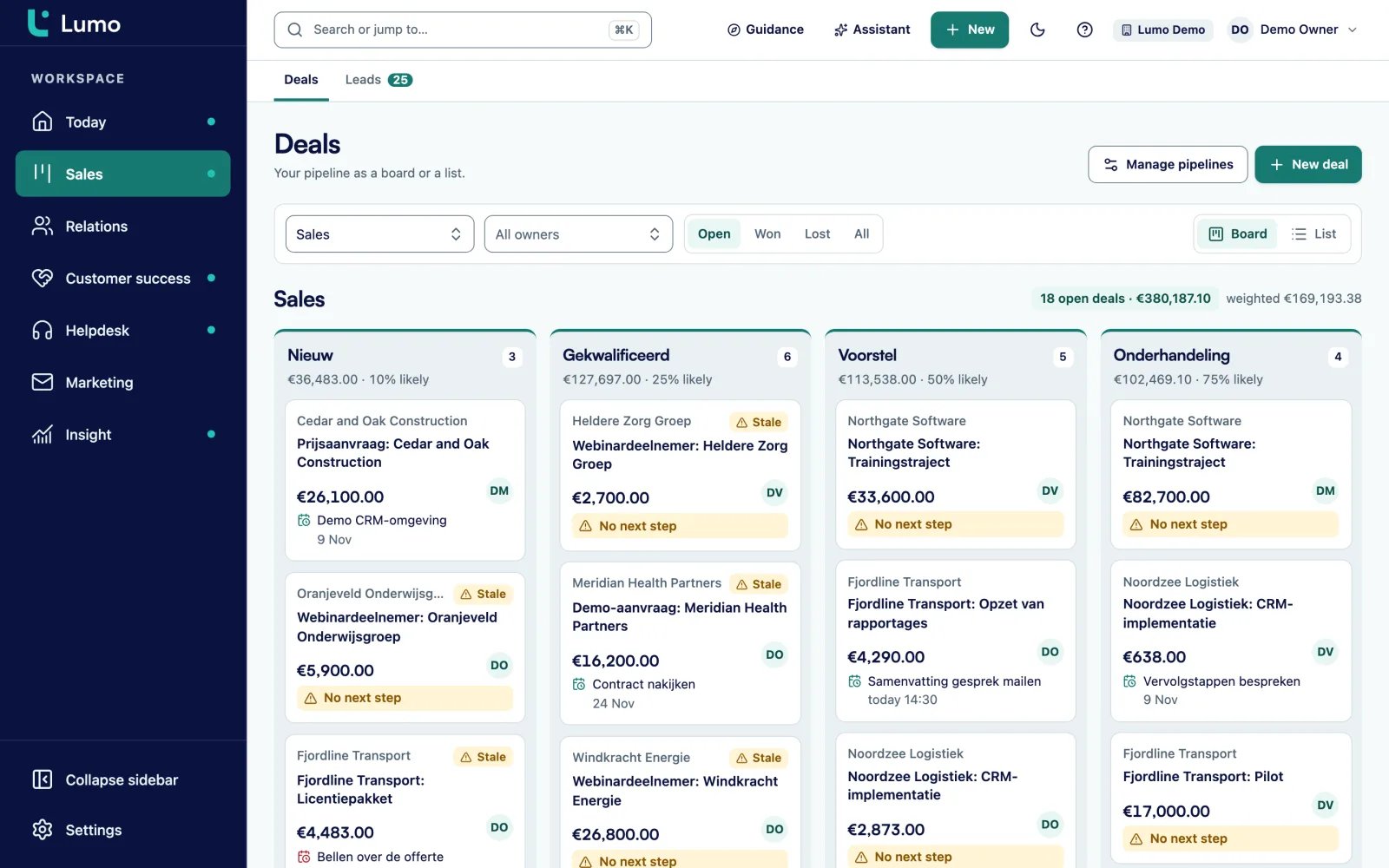
Lumo has no separate screen for exit criteria. You write them into your team's way of working and check them in the sales meeting. If a stage should only be reachable when a field is filled in, a data quality rule can block the save. See guidance and rules.
For B2B a common set is: First meeting booked, Needs confirmed, Demo or proposal discussed, Quote sent, Negotiation, then Won or Lost. Adjust the names to your process, but keep a clear exit criterion for each stage.
Five to seven open stages. Fewer and you cannot see where deals stall. More and reps skip stages. Won and lost do not count.
The condition a deal must meet before moving to the next stage. Always something the buyer said or did, and checkable in a note, email or activity on the deal.
Start with values like 10, 25, 40, 60 and 80 percent. After six months, count per stage how many deals reached it and how many of those were won. Only do this with at least twenty won deals.
A lead has shown interest but is not yet qualified. A deal is a concrete opportunity with a value and an expected close date. Keep them apart or your pipeline will not add up.
When the buyer says no, or after an agreed number of attempts without a response, for example three. Always with a lost reason. You can reopen the deal if the buyer comes back.
If new business, growth and renewals work differently, yes. Each pipeline gets its own stages and win probabilities. Two or three clear pipelines work better than one with twelve stages.
Review stages and exit criteria once a quarter in the sales meeting. Avoid changing names or the number of stages more than twice a year, because every change makes comparing with earlier periods harder. Adjust win probabilities once you have enough closed deals.
A deal that has been in a stage longer than normal. Set a limit per stage, for example one and a half times the average time for won deals. A stalled deal is a reason for a conversation, not automatically a loss.
In a demo we set up your stages with win probability and stall limits in Lumo, so you see how your pipeline looks. Or request a trial workspace.