Put Salesforce and Lumo next to your own process
In the demo we look at which parts of Salesforce you really use. If you need the freedom of a platform, we will say so.
Salesforce is a platform on which you can build almost any CRM. Lumo is a product with a fixed structure that you configure in settings. Here is what that difference means, theme by theme, for a B2B team in the small to mid-market.
Salesforce grew big as a platform. You get a CRM, but you can also build your own objects, processes, screens and code on top. There are separate clouds for sales, service and marketing, and a huge marketplace of extensions. For an international organization with its own processes and its own admin team, that is exactly what you want.
For a B2B team of ten to a hundred people, that freedom sometimes works the other way. Every wish is possible, so every wish gets built. After a few years there is an environment only the admin or the implementation partner still understands. When that person leaves, every change becomes a project. That is not Salesforce's fault. It is the cost of a platform that can do everything.
Lumo is a product. The structure is fixed: persons, organizations, leads, deals, activities, tickets and projects. Within that you configure a lot without code. You create pipelines with stages and win probability, custom fields in twelve field types, roles, labels, data-quality rules and automations. You switch fourteen modules on or off per workspace, from campaigns to helpdesk and live chat.
Sales Surge has done more than 150 CRM implementations. What we learned is that most B2B teams do not get stuck on what the system can do, but on what the team does with it every day. That is why Lumo has in-product guidance: tours, checklists and rules that really stop a deal from being saved without a required field. Below we go through the themes.
Qualitative differences, no prices. Salesforce changes often, so always check the details yourself.
| Topic | Salesforce | Lumo |
|---|---|---|
| Approach | Platform on which you build your own CRM | Product with a fixed structure that you configure |
| Customization | Very high: custom objects, flows and code | Custom fields, pipelines, roles, rules and automations, no custom objects |
| Administration | Usually needs an admin or implementation partner | Managed in settings, without code |
| Modules | Separate clouds for sales, service and marketing | Sales, service and marketing in one product, each module on or off |
| Pipeline | Opportunities with extensive forecasting | Deal board with win probability, weighted value and stalls, forecast as a report |
| Integrations with Outlook and Gmail | Gmail today, Outlook and Microsoft 365 planned, BCC address works with any mail client | |
| Quotes and signing | Through extensions or additional products | Quote built from deal products, signed with an emailed code, with an audit log |
| Service | Service Cloud with many channels | Tickets with SLA targets, customer portal, knowledge base and live chat |
| Marketing | Separate marketing products | Campaigns, segments, forms and consent built in |
| Reporting | Reports and dashboards, plus separate analytics products | Report builder with nine chart types, goals and drill-down |
| AI | Its own AI and agents across the platform | AI assistant that is off by default and asks for approval before outward actions |
| Sign-in | Extensive SSO options | Own login with two-factor authentication, no SSO |
| Extensions | Very large marketplace | REST API, webhooks and an MCP server |
| Mobile | Mobile app | Web app, no mobile app |
Compared on the basis of public information, November 2026. Check the Salesforce website for current details.
Salesforce is strong in forecasting, with its own screens and categories. Lumo has no separate forecast screen. What it does have: every stage has a win probability, the board shows value and weighted value per stage, and you build a weighted forecast as a report. Every stage change is stored with its duration. Products on a deal have a billing frequency, from one-time to annual, with an optional number of cycles. That keeps the deal value right for subscriptions too.
Salesforce connects to Outlook and Gmail. Lumo syncs with Gmail and Google Calendar today, and the Outlook and Microsoft 365 integration is planned. Only mail involving a known contact is stored, and it is matched to person, organization and deal automatically. Google meetings with a known contact become meetings in Lumo, linked to the most recently updated deal. If you work in Outlook, you use the personal BCC address: put it in Bcc or forward a mail to it, and it lands on the right records.
In Salesforce, quotes and signatures often run through extensions or additional products. In Lumo they are built in. The quote takes over the deal products, with VAT, intro text, terms and a valid-until date. The customer signs with a typed name and a six-digit code sent by email. The signed PDF gets an evidence page with time, IP address, device and a SHA-256 hash. Read more about quotes and e-signatures. What you should know: quote documents are in Dutch, and there is one signer per quote.
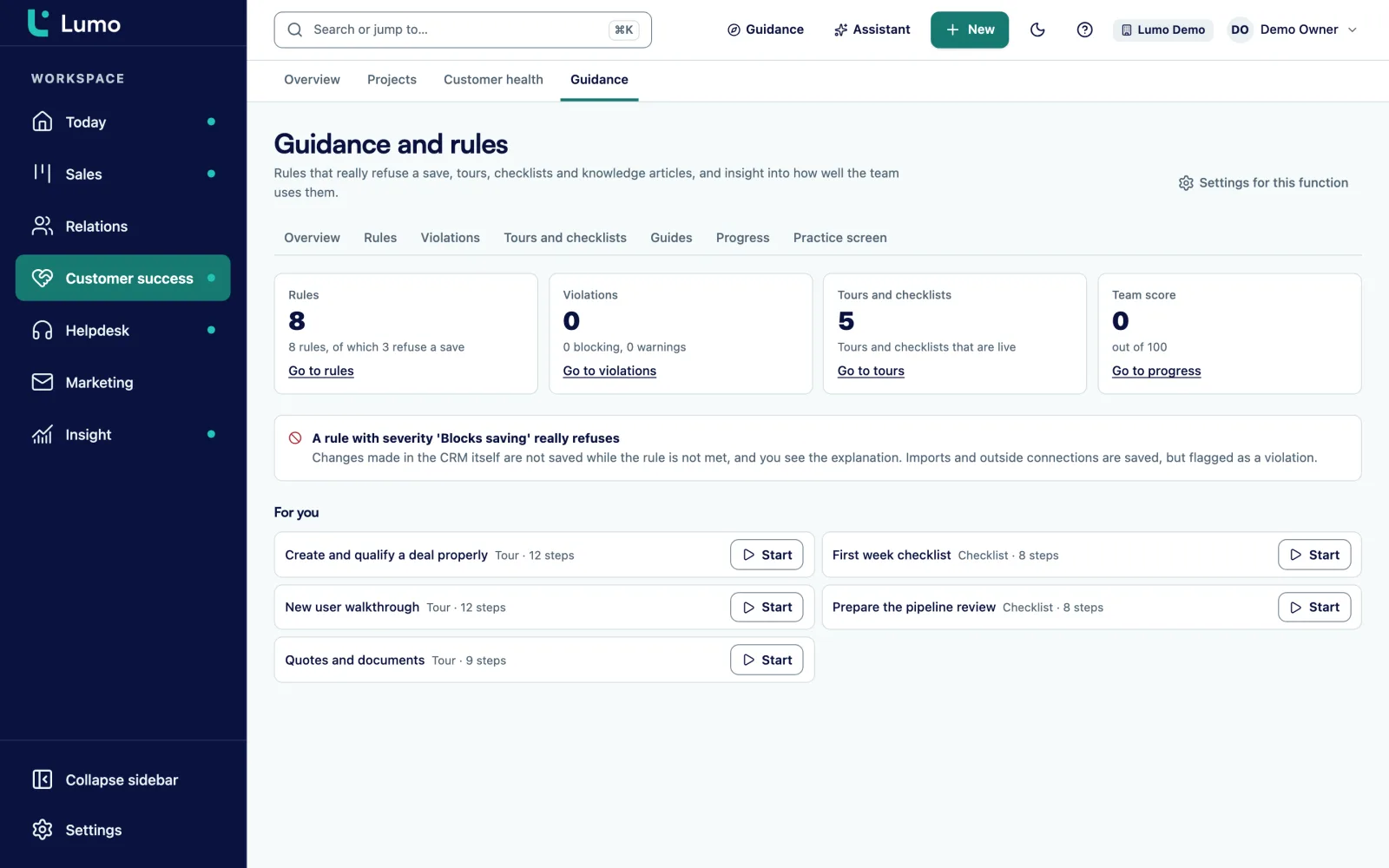
In a large Salesforce environment an admin often guards data quality, with validation rules and reports. In Lumo this sits in the Guidance and rules module, and you switch it on without code. A rule has three levels: tip, warn or block. Block really refuses the save, in the screen and through the API.
There are eight default rules for deals that you install with one click. You also create in-product tours and checklists, and knowledge guides in Markdown. You assign them to people, publish versions and see progress and an adoption score. A new account manager does not have to wait for a training to know how your team works.
Service Cloud is one of the strongest helpdesk products for large contact centres, with many channels. Lumo keeps it smaller and closer to sales. Tickets come from a mailbox, the portal or chat, or are created by hand. There are SLA targets per priority with business hours and a warning at 75 percent, macros, assignment across available agents and a satisfaction survey after solving. Every organization gets a health score from 0 to 100 based on ticket signals. Phone, WhatsApp and a social inbox are not included.
Salesforce has separate marketing products. In Lumo email campaigns and web forms are part of the same product. You send to segments from your filters, consent is checked again at the moment of sending, and an unsubscribe applies to the whole workspace. Forms support multiple steps, conditions, hidden fields for UTM values and double opt-in.
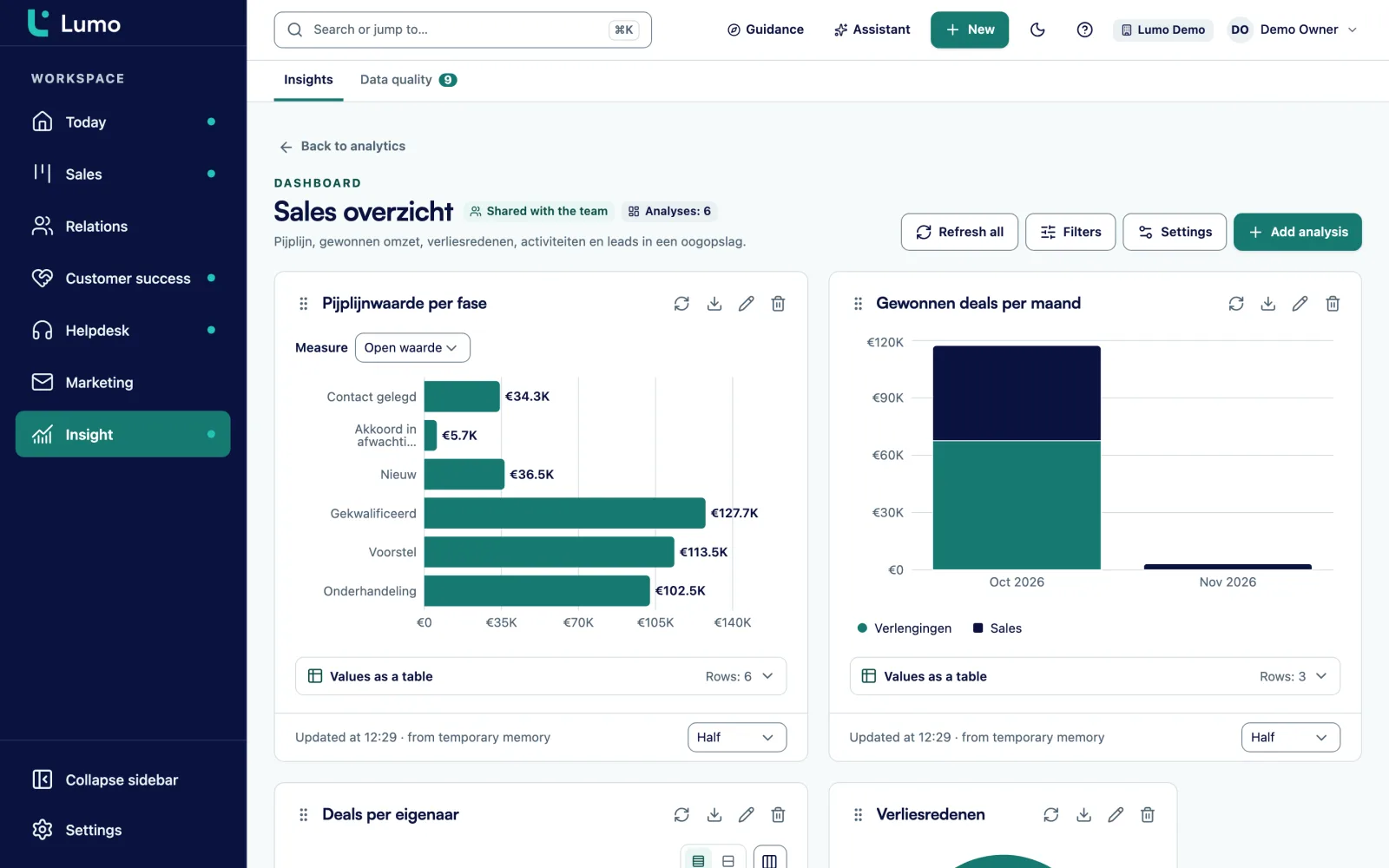
The Lumo report builder has nine chart types, goal lines, periods up to the fiscal year and drill-down to the records. Dashboards are private or shared, and exchange rates keep multi-currency reports correct. For heavy analysis across several systems Salesforce has its own analytics products. Lumo does not, but you can pull data into your own data warehouse through the API and CSV export.
You build a Lumo report in three choices: the source, the measure and the breakdown. You see a preview straight away. The measure can be a count, a sum, a ratio or a percentage. Without an admin, you create a report with the weighted pipeline per owner, or the conversion from lead to deal per source.
Click a bar and you see the records behind it. Every report exports to CSV. You can also ask the AI assistant for a report in plain language, and it builds it for you. Reports see all records in the workspace, because per-record visibility is not enforced yet.
Salesforce builds its own AI and agents across the whole platform. The Lumo AI assistant is more modest and tightly scoped. It searches, creates and updates records, and builds segments, campaigns, automations and reports. Anything outward-facing or irreversible waits for your approval. It runs with your role and permissions, every tool call is logged, and it stays off until an admin switches it on. By default it runs on Google Gemini.
Salesforce has extensive SSO options and field-level security. Lumo has its own login with two-factor authentication, a list of sessions and devices you can sign out remotely, four roles and separation per workspace in the database. The audit log is append-only. Data is hosted in London. There is no SSO, and per-record visibility is not enforced yet.
A Salesforce implementation is often a project of months. You configure Lumo in settings, or have Sales Surge do it. There is no automatic import from Salesforce, so we handle the switch by hand. Read how we approach implementation and onboarding.
Salesforce is one of the largest CRMs in the world for good reasons.
If you have your own admin team and processes that really differ from the standard, Salesforce is strong there.
If three or more of these sound familiar, a demo is worth your time.
There is no automatic import from Salesforce. Sales Surge moves your data by hand.
We look at which objects, fields and processes you use in Salesforce, and which of them you need in Lumo.
Pipelines, stages with win probability, custom fields, roles, rules and the modules you switch on.
We bring over persons, organizations, deals and the rest by hand, and check samples with you.
Gmail and Google Calendar per user, or the BCC address for anyone working in Outlook. Other systems through the API or webhooks.
Training, in-product tours and checklists, and rules that guard data quality from day one.
In Lumo you do not build custom objects or code. If a process really needs that, connect it through the API and webhooks. Sign-in uses its own login with two-factor authentication, not SSO. Data is hosted in London. If you work in Outlook, use the BCC address until the Outlook and Microsoft 365 integration is there.
For B2B teams in the small to mid-market that do not want a dedicated admin, yes. If you need custom objects and code, Salesforce is stronger there.
No. You configure it in settings, without code. Sales Surge can handle the setup. Implementation
Yes, but not through an automatic import. Sales Surge moves your data by hand.
No. You build a weighted forecast as a report using the win probability per stage. Reports
No. There is its own login with two-factor authentication, which you can make mandatory for admins.
Gmail and Google Calendar sync today. The Outlook and Microsoft 365 integration is planned. Until then the personal BCC address works with any mail client.
We do not quote other vendors' prices. Lumo pricing depends on the number of users and the modules you switch on. About pricing
Yes, through the REST API with 49 routes, signed webhooks and an MCP server for AI tools. API and integrations
In the demo we look at which parts of Salesforce you really use. If you need the freedom of a platform, we will say so.